
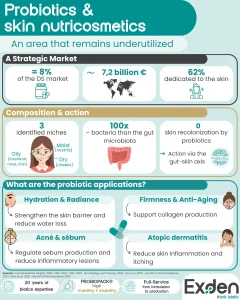
The nutricosmetics market is now worth approximately 7.2 billion euros, with skin care leading the way in sales. It is driven by increasingly informed consumers: 50% had already heard of the skin microbiome in 2026, +4 points in one year.
However, most “beauty microbiome” innovation remains focused on topical skincare (creams, serums). Oral supplementation is a more recent development in this field, but it is already supported by concrete clinical evidence – an approach designed to target underlying mechanisms rather than symptoms.
Probiotics find a natural place here in nutricosmetics, through the gut-skin axis: the interaction between the gut microbiota, inflammation, and the skin barrier. This presents an opportunity for dietary supplement brands seeking to differentiate themselves in a segment currently dominated by topical skincare.
The skin nutricosmetics market: a strategic segment
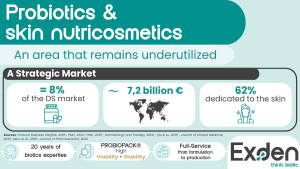
The global nutricosmetics market is currently valued at between 6.8 and 7.6 billion euros, according to research firms.
Compared to the global dietary supplements market, which exceeds 85 billion euros, nutricosmetics account for approximately 8% – a well-established segment.
Within the nutricosmetics sector itself, skin care accounts for the bulk of demand: approximately 62% of the global market in 2026. Research on probiotics is already yielding targeted solutions for several skin conditions.
What types of consumers are interested in nutricosmetics?
Skin nutricosmetics appeal to a wide range of consumer profiles, from the broadest to the most targeted. Five of these profiles currently account for the bulk of demand.
General public: the gateway to the market
The desire for hydration, skin comfort, and a more radiant complexion is a cross-cutting demand in the skin nutricosmetics market, across all ages and demographics. It is also one of the most consistently reported benefits of oral probiotics.
Men: a target market in the process of being destigmatized
Long perceived as a market almost exclusively for women, men’s skincare is on the rise: 42% of men report using it frequently, and 34% want to improve their physical appearance – a rapidly growing segment that is still underserved by dedicated formulations.
Perimenopausal and postmenopausal women: clinical demand and evidence align
Between the ages of 35 and 65, the decline in estrogen accelerates the loss of collagen and elasticity – a mechanism distinct from chronological aging alone. While topical treatments aim to mask visible signs, oral probiotics are proven to target the underlying causes.
Urban workers: skin barrier protection
Pollution and chronic stress: This demographic seeks to protect their skin proactively, before visible signs appear, rather than correcting signs that have already developed. This preventive approach is still largely underserved by dedicated dietary supplements.
Young consumers: acne and atopic dermatitis
Two conditions with distinct needs: acne in adolescents and atopic dermatitis, primarily in children, with forms that sometimes persist into adulthood and impact quality of life.
Skin microbiome and probiotics: two distinct forms of support for the skin barrier
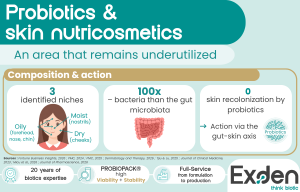
The skin is the body’s second-largest microbial ecosystem after the gut, with a bacterial density approximately 100 times lower (10¹² microorganisms, compared to 10¹⁴ in the gut).
The face, specifically, has the highest bacterial density of any area of the skin – comparable only to the groin and armpits.
More than 1,200 bacterial species have been identified there to date, including three dominant genera across the entire face: Cutibacterium, Staphylococcus, and Corynebacterium.
On the face, these three genera are distributed across three well-defined ecological niches:
1. Sebaceous (oily) areas (forehead, nose, chin): High sebum production in these areas promotes a high bacterial density.
2. Moist areas (nostrils, nasolabial folds): constant moisture in these areas promotes abundant mixed colonization.
3. Dry areas (cheeks): fewer nutrients are available for bacteria, but microbial diversity is higher than in the other two areas.
These niches contribute to healthy skin and, in particular, to its barrier function. In cases of cutaneous dysbiosis – an imbalance in this local ecosystem – the skin’s barrier function is compromised.
Oral probiotics do not act by directly recolonizing this microbiota: their support is exerted remotely, via the gut-skin axis.
A nutricosmetic project based on probiotics? Our R&D experts will support you right from the development phase.
Let’s talk about it: contact@exden.fr
The gut-skin axis: four interconnected pathways
The gut-skin axis encompasses the pathways through which the gut ecosystem communicates with the skin. Four mechanisms are involved, all of which are interdependent. Probiotics are being studied as a way to influence this entire system.
The intestinal barrier
The intestine is protected by a wall that allows nutrients to pass through while retaining bacteria. An imbalanced microbiota compromises this filtration: bacterial fragments (LPS) then pass through in excess, potentially leading to metabolic endotoxemia and a state of inflammation affecting the skin.
Microbial metabolites (SCFAs)
The fermentation of fiber by gut bacteria produces short-chain fatty acids, which contribute to the strength of the intestinal wall and to immune regulation. Their production declines with reduced microbial diversity – one of the ways in which gut balance indirectly affects the skin.
The intestinal immune system
The gut is home to a large proportion of the body’s immune cells. There, the microbiota regulates the balance between pro-inflammatory and regulatory cells – a mechanism that modulates the skin’s unique inflammatory environment.
Skin inflammaging
This term refers to the systemic, silent inflammation that develops with age. It is believed to activate enzymes that break down collagen and elastin and to slow down skin repair – a mechanism that is currently one of the most extensively studied in research on skin aging.
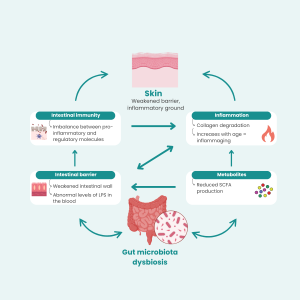
The four pathways of the gut-skin axis, as they are activated in cases of intestinal dysbiosis.
Translating science into a stable and effective formula: that is precisely what Exden has been doing for nearly 20 years. Discover our expertise.
Probiotics and the skin: clinically documented effects
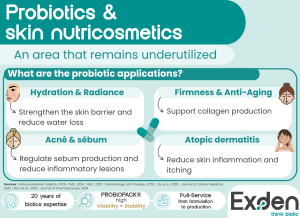
Oral probiotics are currently being studied for a range of skin benefits, from hydration to the most specific dermatological conditions. This field of research has expanded significantly in recent years, as the gut-skin axis gains greater scientific recognition.
Hydration and the skin barrier
Several independent clinical trials report an increase in protective lipid levels and a strengthening of skin junctions, associated with a reinforced barrier and improved skin hydration.
Firmness and anti-Aging
Collagen production increases thanks to probiotics, with measurable effects on skin elasticity and, for certain strains, on markers of photoaging.
Perimenopausal skin
Available data indicate a slowing of collagen breakdown associated with an improvement in overall skin parameters in perimenopausal women taking probiotic supplements.
Acne and Sebum Regulation
According to a meta-analysis, inflammatory lesions are reduced by probiotics, with sebum production regulated depending on the strain – both mechanisms being central to acne.
Atopic dermatitis and psoriasis
The severity of lesions and pruritus decrease with probiotic supplementation – an effect consistent with the immune and inflammatory mechanisms already described for the gut-skin axis.
Positioning and distribution: what should you choose for your probiotic range?
The right choice depends on several factors specific to your project:
- The formula: The desired effect – whether broad-spectrum or targeted – guides the selection of strains and their dosages.
- The target audience: Each consumer profile requires a different level of evidence and a different message.
- Dosage form: capsules, sticks, oils – each format corresponds to a different consumer profile or consumption pattern.
- Existing product line: The new product must align with your existing active ingredients and distribution channels.
These factors cannot be chosen in isolation: each decision influences the others.
Exden supports your entire project with full-service and private-label solutions, from formulation to manufacturing. Let’s talk: contact@exden.fr
Q&A Probiotics and nutricosmetics for the skin: your questions, science-based answers
Is it possible to combine probiotics with another nutricosmetic active ingredient?
Yes, under certain conditions: compatibility depends on the strain selected and the associated active ingredient. It must be validated during the formulation stage to ensure the probiotic remains viable until the expiration date.
Which strains should be prioritized for a nutricosmetic facial formula?
The effects are strictly strain-dependent. The choice should be guided by available clinical data on the targeted indication, the validated dosage, and compatibility with the other active ingredients in the formula.
Targeted effect or broad-spectrum effect: how do you choose your positioning?
It depends on your formula, your target audience, and the rest of your product line. We help you navigate this decision-making process from the very beginning of the formulation process.
How long should supplementation last to objectively measure an effect?
It depends on the strain, the dosage, and the targeted indication. As a general guideline, most clinical studies evaluate effects after one to several weeks of continuous use.
Can skin benefits be promoted with probiotics under current regulations?
In France, the DGCCRF tolerates the term “probiotic” as a category name on labeling but only authorizes the claim “contributes to the balance of intestinal flora.” No beauty or skin-related claims linked to probiotics are therefore permitted at this time. However, adding other ingredients that support such claims can help you position your product along these lines.
Next step: hair and epidermal structures
The gut-skin axis does not end at the facial epidermis. The hair follicle, which is equally sensitive to inflammation, is studied as a natural extension of this axis. A recent clinical trial reported fewer hairs in the shedding phase (telogen) among participants taking probiotics.
This is still a relatively new field, but one that is sufficiently well-established to warrant its own discussion – which we’ll explore in an upcoming article.
Toward a New Generation of Nutricosmetic Formulas for the Face
Today, skin health is better understood as resting on two distinct pillars: the skin microbiome, which acts through direct contact with the skin, and the balance of the gut microbiome, which acts remotely via the gut-skin axis. It is through this second mechanism that probiotics exert their effects:
- Strengthening the intestinal barrier and limiting the passage of LPS into the bloodstream;
- Regulating the balance between pro-inflammatory and regulatory immune cells;
- Producing SCFAs that strengthen the intestinal wall and limit inflammation at a distance;
- Reducing low-grade systemic inflammation (inflammaging), a common underlying factor in several skin conditions.
Several clinical trials confirm measurable benefits for numerous skin conditions, depending on the strain and indication.
For a brand, the challenge lies in selecting the indication, target audience, and formulation best suited to its positioning – an area that remains largely untapped in the topical skincare market.
Do you have a project involving probiotic and skin nutricosmetic formulations?
Are you a dietary supplement brand looking to enter the nutricosmetics market with a scientifically unique formulation?
Exden works with you to develop probiotic formulations that incorporate the latest advances in gut-skin research:
- Selection of strains tailored to your indication and target audience.
- Customized formulations with synergistic combinations of active ingredients for the skin and appendages.
- ISO 22000-certified manufacturing in France.
- Maximized viability and stability with Probiopack®.
Let’s discuss your project: contact@exden.fr
Enora Lehuédé, Marketing Project Manager – Exden
Get the key points in one infographic
References
(8) Fortune Business Insights (2026). Taille du marché de la nutricosmétique.
(9) InsightAce Analytic (2026). Microbiome Cosmetics Market Size, Share and Forecast 2026 to 2035.