
In France, osteoarthritis affects around 10 million people (Inserm, 2025) – the country’s leading rheumatic disease.
Yet, at comparable ages and lifestyles, some people develop severe osteoarthritis and others don’t.
Science has identified a still-underexploited lever to explain this gap: the gut-joint axis, the dialogue between the gut microbiota and joint inflammation.
A strong signal is emerging for supplement brands seeking differentiating positioning in a market that has been dominated for years by the same active ingredients.
The joint health market: a mature sector in search of differentiation
Driven by an aging population, growing sedentary lifestyles, and increasing public awareness, the global joint health market (of which osteoarthritis is the leading indication) is worth approximately €11 billion today.
Demand for joint-focused dietary supplements keeps growing, driven by well-identified consumer profiles.
Which profiles are affected by osteoarthritis?
A report published in the nutraceutical magazine Actif’s reveals that half of respondents have already suffered from joint pain, and 80% anticipate a future risk – a strong signal of preventive demand. Three profiles account for most of this demand:
- Seniors: 65% of people over 65 are affected in France, with a documented impact on quality of life, sleep, and mobility.
- Menopausal women: the drop in estrogen accelerates cartilage degradation through a mechanism distinct from osteoporosis – a specific positioning angle that remains underexploited.
- Active individuals in prevention mode: athletes and health professionals exposed to repeated joint strain, who take preventive action before the first symptoms appear.
Aging and prevention: a demand that will only grow
Demographic aging and rising sedentary lifestyles are creating structural demand for joint prevention – a form of prevention that is starting earlier and earlier, even before pain appears.
Yet the historical active ingredients (collagen, chondroitin…) still target a single model: mechanical wear of the cartilage. A model that is now incomplete. The gut-joint axis opens up a differentiation angle that remains largely untapped.
Have a project for a biotics-based joint formulation? Our R&D experts can support you from the development stage onward. Let’s talk: contact@exden.fr
How osteoarthritis develops: far more than mechanical wear
Osteoarthritis results from two distinct mechanisms: mechanical wear of the cartilage and a chronic inflammatory environment that accelerates its degradation.
This second lever is often underestimated – yet it’s precisely what explains why, at comparable lifestyles, some people develop severe osteoarthritis and others don’t.
Cartilage, a tissue poorly equipped to regenerate
Unlike skin or muscle, cartilage is avascular: it has no direct blood supply and depends entirely on synovial fluid to receive nutrients.
Its cells – chondrocytes – ensure its renewal, but at a very slow pace.
Once degradation begins, repair capacity is insufficient to reverse it — which makes upstream prevention all the more strategic for brands looking to position themselves early on this axis.
Inflammaging, the silent determinant
Inflammaging refers to the chronic, low-grade systemic inflammation that gradually sets in with age, independently of joint wear. It is today one of the most studied markers in longevity research, with osteoarthritis being just one of its joint-related expressions.
Its mechanism is cumulative:
- Accumulation of pro-inflammatory mediators,
- Activation of enzymes that degrade cartilage proteins,
- Simultaneous inhibition of reconstruction signals.
The role of the microbiota: a full-fledged player
With age, the microbiota loses diversity and the intestinal barrier weakens — two phenomena that amplify inflammaging. In women, menopause adds a hormonal dimension via the “estrobolome”: the depletion of bacteria that regulate circulating estrogen intensifies this inflammatory environment.
This is precisely where the gut-joint axis comes into play.
The gut-joint axis: four pathways of communication
The gut-joint axis refers to the communication network between gut ecology and joint health, operating through four biological pathways.
The intestinal barrier
The gut is lined with a thin wall that lets nutrients through while blocking bacteria. When the microbiota becomes imbalanced, this wall weakens:
- Bacterial fragments (LPS) then pass into the bloodstream in abnormal amounts – a phenomenon called metabolic endotoxemia.
- Studies have measured a correlation between circulating LPS levels and the severity of joint damage.
Microbial metabolites
By digesting dietary fiber, gut bacteria produce short-chain fatty acids (SCFAs), which strengthen the intestinal wall and regulate the immune response. A microbiota low in diversity produces less of them.
Recent work indicates that these SCFAs also act more directly on the joint: they help limit cartilage degradation and reduce inflammation of the synovial membrane.
The gut immune system
A significant share of the body’s immune cells is concentrated in the gut.
There, the microbiota regulates the balance between pro-inflammatory and regulatory cells – a mechanism that directly modulates the inflammatory environment underlying osteoarthritis.
Remodeling of subchondral bone
Osteoarthritis also affects subchondral bone, the layer of bone beneath the cartilage, which densifies and remodels as the disease progresses – a component of the disease in its own right.
The microbiota also plays a role here, through SCFAs that help limit bone resorption and support calcium and magnesium absorption. This pathway is distinct from general bone health: it concerns the joint’s own structure, not the skeleton as a whole.
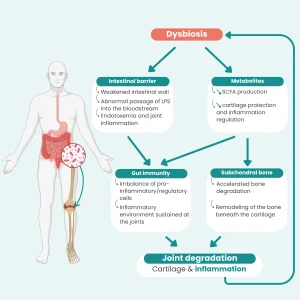
It is through these four pathways that probiotics act – by rebalancing a disrupted microbiota rather than acting directly on the joint.
Translating science into a stable, effective formula: that’s precisely what Exden has been doing for over 18 years – from strain selection to finished product. Discover our expertise.
Probiotics and osteoarthritis: where clinical research stands today
Several randomized, placebo-controlled trials have evaluated probiotic supplementation in osteoarthritis patients, over periods ranging from 12 weeks to 6 months. The results converge:
- Reduced pain;
- Improved daily mobility (walking, balance, grip strength);
- Lower blood markers of inflammation;
- Repair of intestinal permeability measured in one of the trials, in connection with the clinical improvement observed.
Combining biotics with other joint-health actives
Combinations of biotics and classic joint-health actives show promising results: one clinical trial demonstrated that a probiotic strain, added to the treatment of menopausal women suffering from knee osteoarthritis, significantly enhanced its effectiveness.
That said, not all combinations are equal. Ingredient compatibility, synergy of action, and the stability of the final formula are interdependent parameters – ones that need to be addressed as early as the formulation stage.
Exden supports your entire project on a full-service basis, from formulation to manufacturing. Let’s talk: contact@exden.fr
FAQ: Probiotics and Osteoarthritis – Your Questions, Answered by Science
What is the mechanism of action of probiotics on the joint?
The action is indirect, via the gut-joint axis. By rebalancing the microbiota, probiotics strengthen the intestinal barrier, limit metabolic endotoxemia, and modulate systemic inflammation – creating an environment less favorable to the degradation of cartilage and subchondral bone.
How do you choose the right strain for a joint formula?
Effects are strictly strain-dependent. A clinical result obtained with one strain does not transfer to another, even a biologically similar one. Strain selection should be guided by the clinical data available for the targeted indication, the validated dosage, and compatibility with the formula’s other active ingredients.
Is it relevant to combine biotics and classic joint actives in the same formula?
Some combinations have demonstrated superior efficacy compared to treatment alone. But not all combinations are equal: pairing two actives that are each effective on their own does not guarantee a superior result in the finished formula. This is a formulation challenge in its own right, one that needs to be considered from the product’s conception onward.
What are the clinical benefits of probiotic supplementation for osteoarthritis?
In osteoarthritis patients, several randomized, placebo-controlled trials lasting 12 weeks to 6 months show measurable benefits: reduced pain, improved mobility, and lower inflammatory markers.
Probiotics or postbiotics for a joint formula?
Probiotics currently have the strongest level of clinical evidence on the gut-joint axis – several randomized trials document measurable benefits on pain, mobility, and inflammatory markers. Postbiotics offer better galenic stability, but their clinical evidence on this axis remains, at this stage, mixed.
Can probiotics act on the progression of osteoarthritis, beyond symptom relief?
Animal studies show a reduction in structural cartilage damage – an encouraging signal of a potential effect beyond symptom relief. Available clinical trials, meanwhile, measure pain and mobility, not the disease’s structural progression. This is a research area to watch.
Toward a new generation of joint formulas
Osteoarthritis is now better understood as a disease with two components: mechanical wear of the cartilage and a chronic inflammatory environment sustained, in part, by an imbalanced microbiota.
It is precisely on this second lever that probiotics act:
- Strengthening the intestinal barrier and limiting metabolic endotoxemia;
- Regulating the balance between pro-inflammatory and regulatory immune cells;
- Increasing the production of cartilage-protective SCFAs;
- Supporting subchondral bone – a structure specific to the joint, distinct from general bone health.
Several clinical trials already confirm measurable benefits on pain and mobility.
The gut-joint axis opens the door to a new generation of joint formulas – more differentiated than the historical actives alone, and grounded in a rapidly expanding field of science.
Do you have a biotics-based joint formula project?
Are you a dietary supplement brand looking to position yourself in the joint health market with a scientifically differentiated formulation?
Exden designs your biotics formulation with you, incorporating the latest advances in the gut-joint axis:
- Selection of strains suited to your indication and target audience.
- Custom formulation with synergistic combinations of joint-health actives.
- French manufacturing, ISO 22000 certified.
- Maximized viability and stability with Probiopack®.
Let’s talk about your project: contact@exden.fr
Enora Lehuédé, Marketing Project Manager – Exden
References
(7) Inserm (2025). Dossier Arthrose.
(8) Actif’s Mag, édition 95 (avril–mai–juin 2026). Dossier « Santé osseuse et articulaire ».
(9) Euromonitor International (2026). Estimation du marché mondial de la santé articulaire.