
In 2025, 41% of French people reported living with chronic stress (Synadiet Barometer) – a strong signal for dietary supplement brands seeking to differentiate themselves in high-potential market segments.
Science has identified a lever that remains under-exploited: psychobiotics, biotic active ingredients that act directly on the gut-brain axis to support mental health.
Stress and gut microbiota: the vicious circle documented by science
The link between stress and gut microbiota is now one of the most dynamic areas of research in mental health. Stress is often perceived as a purely psychological problem. However, the biological reality is more complex.
What chronic stress actually does to your microbiota
Under the effect of prolonged stress, the body triggers a cascade of reactions: cortisol secretion, sleep disruption, and impaired concentration.
Research clearly establishes that these reactions profoundly alter the composition of the gut microbiota:
- A decrease in bacterial diversity;
- Reduction in beneficial bacteria, particularly the genera Lactobacillus and Bifidobacterium;
- Proliferation of pro-inflammatory species.
Stress also affects the permeability of the intestinal barrier: cortisol reduces the expression of tight junction proteins, making the intestinal wall porous, which allows bacterial compounds to enter the bloodstream.
Dysbiosis and mental health: when the gut exacerbates distress
These disruptions to the microbiota – a decline in bacterial diversity, a reduction in beneficial species, and the proliferation of pro-inflammatory bacteria – constitute what science refers to as dysbiosis.
This state of imbalance disrupts the production of molecules essential for brain function.
In cases of marked dysbiosis, the intestinal barrier can become more permeable, allowing certain bacterial compounds to enter the bloodstream. This low-grade inflammation, when it becomes chronic, is associated in the literature with a deterioration in mood, sleep quality and cognitive abilities – though it is not the sole cause.
The mechanism is circular: the more intense the stress, the more the microbiota becomes unbalanced – and the more unbalanced the microbiota is, the less equipped the body is to regulate stress.
People suffering from chronic stress or depression frequently have an altered microbiota, with a marked reduction in protective bacteria. It is precisely this dynamic that psychobiotics target.
Are you developing a dietary supplement targeting the stress/microbiota axis? Our experts will analyse your project and guide you towards the most relevant probiotics and active ingredients. Let’s discuss it
The gut-brain axis: understanding the four communication pathways
To understand how psychobiotics affect stress, we must first understand the pathway they take: the gut-brain axis.
A constant, two-way communication
The gut-brain axis refers to the constant, two-way communication network between the digestive system and the brain, via four simultaneous pathways: the nervous, hormonal, immune and blood systems.
This network is so complex that scientists refer to the gut as the ‘second brain’: it is home to 200 million neurons and 70% of the body’s immune cells.
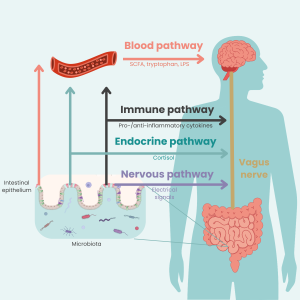
1. The vagus nerve: the direct neural pathway between the gut and the brain
Specialised cells lining the gut wall constantly monitor the state of the gut microbiota and transmit this information to the brain via electrical signals from the vagus nerve: bacterial composition, molecules produced, and levels of inflammation.
Under chronic stress, cortisol reduces the sensitivity of these fibres: the vagus nerve is less responsive to the gut, and stress regulation deteriorates as a result.
2. The hormonal pathway: how the microbiota regulates cortisol via the HPA axis
Gut bacteria modulate the hypothalamic-pituitary-adrenal (HPA) axis, the system that orchestrates the hormonal response to stress and regulates cortisol secretion.
Under normal conditions, this axis is activated in response to stress and then returns to equilibrium. Under chronic stress, this regulatory mechanism becomes disrupted: cortisol levels remain elevated for prolonged periods, with knock-on effects on mood, concentration and sleep.
An unbalanced microbiota amplifies this disruption by interfering with the signals the gut sends to the brain.
3. The immune pathway: intestinal inflammation, a messenger of stress to the brain
Around 70% of the body’s immune cells are found in the gut. The gut microbiota constantly interacts with them to maintain a balance between inflammation and protection.
When this balance is disrupted by stress, the intestinal barrier becomes porous: bacterial compounds enter the bloodstream and can trigger systemic inflammation.
When this reaches the brain, it activates microglia (the brain’s immune cells), leading to local neuroinflammation, the effects of which are felt in mood, sleep and cognition.
4. The bloodstream: molecules from the microbiota serving the brain
The bloodstream is the cross-connecting pathway that links all the others. It is via the blood that active molecules produced by the microbiota travel to the brain, and vice versa. Three types of messengers are particularly important:
- SCFAs (short-chain fatty acids): butyrate, propionate and acetate, produced by the fermentation of fibre by gut bacteria. These metabolites cross the blood-brain barrier and act directly on neurons and glial cells.
- Tryptophan: a precursor of serotonin, which regulates mood. Tryptophan does not cross the blood-brain barrier directly: its concentration in the blood – modulated by the microbiota – directly influences the brain’s ability to produce its own serotonin.
- Inflammatory compounds, particularly lipopolysaccharides (LPS) derived from bacteria, which enter the bloodstream when the intestinal barrier is compromised and exacerbate inflammation.
These four pathways form an integrated network: an imbalance in one affects the others. It is on this whole system that psychobiotics act.
An effective psychobiotic formula acts on these different pathways. Discover how Exden translates this approach into practical recommendations. Our expertise
The gut microbiota and chronic stress: which everyday factors compromise the gut-brain axis?
Chronic stress is not the only factor that disrupts the balance of the gut microbiota and compromises the gut-brain axis.
Diet: the primary modulator of the gut microbiota
Diet is the most powerful and direct factor influencing the composition of the microbiota. A diet rich in fibre and fermented foods promotes microbial diversity and the production of SCFAs.
Conversely, an ultra-processed diet deprives the microbiota of the fibre it needs: less diversity, fewer SCFAs, less protection.
Sleep and the microbiota: a two-way relationship
The microbiota follows a circadian rhythm. Poor-quality sleep disrupts its composition, and an unbalanced microbiota in turn impairs sleep quality, particularly by influencing melatonin and cortisol levels.
This circular relationship reinforces the value of psychobiotics in addressing the stress/sleep/mental fatigue triad.
Physical activity and microbial diversity: an established link
Regular exercise is associated with greater microbial diversity and improved resilience to stress. In particular, it promotes the production of GCA and positively modulates the HPA axis response.
A sedentary lifestyle produces the opposite effect: a depleted microbiota that is less resilient to stress.
Antibiotics and other medicines: long-lasting effects on the gut microbiota
Antibiotics have a major and often long-lasting impact on the gut microbiota. Repeated use significantly reduces microbial diversity, sometimes for several months.
Certain other medicines, including non-steroidal anti-inflammatory drugs, have also been shown to affect the composition of the gut microbiota.
What is a psychobiotic? Scientific definition and differences from probiotics
A definition coined in 2013, refined by science
A psychobiotic is a living microorganism or a substrate which, when ingested in sufficient quantities, produces a benefit for mental health by acting on the microbiota and the gut-brain axis.
The term was introduced into the scientific literature in 2013 by researchers Dinan, Stanton and Cryan, who defined it as:
‘a living organism that, when ingested in sufficient quantities, provides a health benefit to patients suffering from psychiatric disorders.’
(Biological Psychiatry, 2013)
Initially, the definition applied only to a subset of probiotics targeting clinical psychiatry. In 2016, it was expanded to include any substance capable of modifying the microbiome with the aim of improving mental health, including indirectly.
Prebiotics – substrates that promote the growth of bacteria beneficial to mental health – and synbiotics – combinations of live microorganisms and substrates designed to act jointly on the microbiome – now fall into this category.
Psychobiotics vs probiotics: what is the real difference?
Probiotic: a live microorganism which, when consumed in adequate quantities, confers a health benefit on the host, according to the ISAPP. Its scope of action covers many areas of health, beyond digestion.
Psychobiotic: a live microorganism or substrate which, when ingested in adequate quantities, produces a benefit for mental health via an action on the microbiota and the gut-brain axis.
Conclusion: not all probiotics are psychobiotics. And not all psychobiotics are probiotics: prebiotics and synbiotics with documented effects on the gut-brain axis are also included.
It is the effect on mental health that defines a psychobiotic, not its nature.
Generic or clinically documented psychobiotic – the choice determines your market positioning. Let’s discuss your project
How do psychobiotics affect stress? The 4 key mechanisms
Psychobiotics do not act via a single pathway of the gut-brain axis, but in a multimodal manner, simultaneously via the four pathways described below.
1. Rebalancing the microbiota: the fundamental mechanism of psychobiotic action
By restoring beneficial microbial diversity, psychobiotics create the conditions for more harmonious gut-brain communication.
In practical terms, they improve the quality of the signals that the microbiota sends to the brain via the vagus nerve, whilst limiting the proliferation of pro-inflammatory species.
This is the fundamental mechanism upon which all other effects are based.
2. Cortisol modulation: how psychobiotics regulate the HPA axis
Several clinical trials show that certain psychobiotics help to moderate cortisol secretion. Significant reductions in salivary cortisol have been measured in participants suffering from chronic stress following supplementation.
This mechanism involves the HPA axis: by acting on the signals the gut sends to the brain, psychobiotics help to recalibrate the hormonal response to stress.
3. Strengthening the gut barrier and reducing systemic inflammation
By strengthening the intestinal barrier, psychobiotics limit the passage of inflammatory compounds into the systemic circulation. In particular, they restore the expression of junction proteins that ensure the integrity of this barrier.
By rebalancing the immune response, they also help to reduce systemic inflammation.
4. Improved supply of neurotransmitter precursors to the brain
By promoting the production of AGCCs and regulating the availability of tryptophan in the blood, psychobiotics directly improve the brain’s supply of molecules essential for mental balance.
A rebalanced microbiota means a blood-brain barrier better supplied with tryptophan, and therefore a brain better equipped to produce its own serotonin.
Psychobiotics and mental health: what clinical trials show
Solid and converging clinical evidence
The results of research into psychobiotics are now sufficiently robust and consistent to guide the formulation of mental wellbeing products.
A 2024 meta-analysis (Nutrients) covering 51 randomised clinical trials (3,353 patients) confirms measurable efficacy on perceived stress, anxiety and depressive symptoms. These improvements are accompanied by measurable biological changes: a reduction in inflammatory markers, an increase in protective metabolites, and normalisation of cortisol levels.
Furthermore, the effects depend on the specific psychobiotic: a psychobiotic that has demonstrated an effect on stress will not necessarily have an effect on sleep. It is this level of precision that distinguishes a high-performance formula from a generic one.
What this means in practical terms for formulating a psychobiotic product
Behind every effective formula lies a rigorous review of the scientific literature: level of clinical evidence, dosage, duration of treatment, responder profile, and synergistic combinations of active ingredients.
At Exden, every strain recommendation is based on a rigorous review of the scientific literature, combined with Probiopack® to maximise viability right up to consumption. Our full-service offering
Q&A: Psychobiotics and stress: your questions, science’s answers
What is the difference between a probiotic and a psychobiotic?
Not all probiotics are psychobiotics, and not all psychobiotics are probiotics. A psychobiotic is specifically selected for its documented effect on mental health via the gut-brain axis. Prebiotics and synbiotics may also have psychobiotic potential.
Can psychobiotics also help with sleep and mental fatigue?
Yes. Several clinical studies report improvements in sleep quality and a reduction in fatigue among participants taking supplements, two symptoms that will top the list of complaints among the French population by 2025.
Are all psychobiotic probiotics the same?
No. The effects depend entirely on the strain used: results obtained with one strain cannot be extrapolated to others, even within the same bacterial genus and species. The choice of clinically validated active ingredients is crucial to the product’s efficacy.
How do I choose the right psychobiotic for my formulation?
The choice of active ingredients depends on your target audience, your positioning and the level of evidence you wish to claim. Discover our full-service offering: https://www.exden.fr/en/full-service-2/
What this means for your formulation strategy
“All disease begins in the gut.” This phrase, often attributed to Hippocrates over 2,400 years ago, has never seemed more relevant.
Science has proven it: stress disrupts the gut microbiota, which in turn amplifies the stress response. This vicious circle involves four specific communication pathways between the gut and the brain: nervous, hormonal, immune and haematic.
Psychobiotics specifically target these pathways:
- Rebalance the microbiota;
- Modulate cortisol;
- Strengthen the gut barrier;
- Improve the brain’s supply of neurotransmitter precursors.
A meta-analysis involving over 3,000 patients confirms their clinical efficacy against stress, the second most common complaint among the French in 2025.
Do you have a psychobiotic formula project?
At Exden, we have been designing and manufacturing biotic-based food supplements for over 18 years. As specialists in formulation and contract manufacturing in France, we support brands from the selection of active ingredients right through to the delivery of the finished product.
Our expertise covers the entire process:
- Analysis and selection of probiotic active ingredients tailored to your target audience
- Bespoke or private label formulation
- ISO 22000-certified manufacturing, 100% French
- Regulatory support
Let’s discuss your project: contact@exden.fr
Enora Lehuédé, Marketing Project Manager
References
(1) Synadiet